Find fast, reliable internet in Salt Lake City—whether you live in an apartment, condo, or single-family home. Compare top providers by exact address, speed, and price to get the best connection for your needs.
Salt Lake City stands out as one of Utah’s most advanced broadband markets
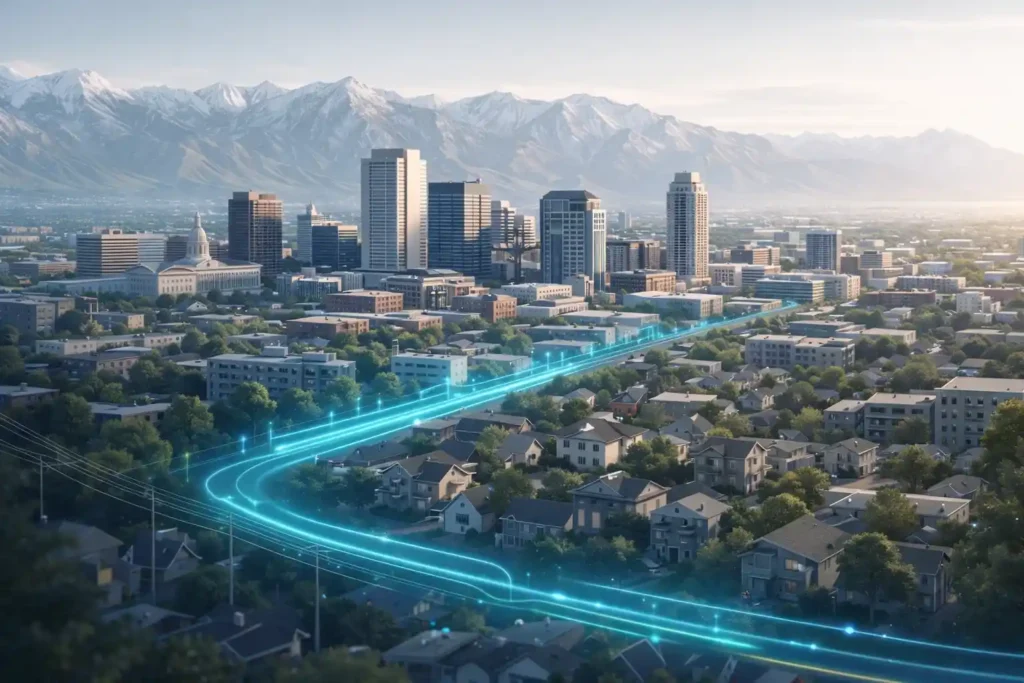
However, availability still varies by neighborhood and building, especially for apartments. Some areas have multiple fiber choices, while others rely on cable or legacy DSL—making address-level checks essential.
Internet delivered through fiber-optic cables
Best for:Remote workers, families, streamers, gamers, smart homes
Internet delivered through cable TV lines
Best for:Apartments or homes without fiber access
Internet delivered over phone lines
Best for: Emergency or light-use situations only
Salt Lake City benefits from Utah’s fiber-first strategy, including:
Neighborhoods like Downtown, Sugar House, The Avenues, and parts of South Salt Lake often have multiple fiber options, especially in newer or recently upgraded areas.
Apartment buildings may limit provider choice—even in fiber-rich neighborhoods. Always check using your full address and unit number.
$70/mo
1,000 Mbps
Remote work, streaming
No data caps
$65–$75
~1,000 Mbps
Families, students
Multiple ISPs
$50–$70/mo
300 – 940 Mbps
Homes
Stable fiber
$60/mo
300–1,000 Mbps
Families
Limited areas
$50/mo
100 – 400 Mbps
Apartments
Promo pricing
$45–$60/mo
10 – 50 Mbps
Light Users Only
Avoid if possible
Availability: Select Salt Lake City neighborhoods
Typical Price: ~$70/month
Typical Speed: 1,000 Mbps
Best for: Remote workers, tech professionals, heavy streaming households
Availability: Many Salt Lake City neighborhoods
Typical Price:~$65–$75/month
Typical Speed:~1,000 Mbps
Best for: Families, students, work-from-home users
Availability: Widely available
Lowest Price Plan: ~$50/mo (~$70–$80 after promo)
Typical Speed: ~100–1,200 Mbps
Best for: Apartments and homes without fiber access
Availability: Select areas
Price Range: ~$50–$70/month
Typical Speed: 300–940 Mbps
Best for: Homes needing fiber where UTOPIA/Google Fiber isn’t available
Availability: Limited areas
Lowest Price Plan: ~$60/month
Typical Speed: ~300–1,000 Mbps
Best for: Families in covered areas
Availability: Via fiber or cable partnerships
Speed: Depends on infrastructure
Best for: Homes with EarthLink fiber access


The best internet providers in Salt Lake City depend on your exact address, but top options include Google Fiber, ISPs operating on the UTOPIA Fiber network, Xfinity, Quantum Fiber (CenturyLink), TDS Telecom, and EarthLink.
Fiber providers generally offer the fastest speeds and best reliability, while cable works well where fiber is unavailable.
Salt Lake City is one of Utah’s strongest fiber markets, but fiber is not available at every address. Many neighborhoods—especially Downtown, Sugar House, The Avenues, and South Salt Lake—have strong fiber coverage. However, availability can vary street by street or building by building, particularly for apartments.
Internet infrastructure was built in phases. Newer neighborhoods and areas included in fiber expansion projects often have multiple fiber choices, while older areas may still rely on cable or DSL. Apartment buildings may also have exclusive agreements that limit which providers can serve residents.
Fiber internet is the best option for remote work. It offers:
A 300 Mbps or higher fiber plan is ideal for most remote workers, while households with multiple remote users may prefer 1 Gbps.
Speed needs vary by usage:
Fiber plans deliver more consistent real-world speeds than cable or DSL.
Yes. Cable internet is widely available in Salt Lake City and offers fast download speeds suitable for streaming and general use. However, cable typically has:
Cable works well as a backup option when fiber is unavailable.
In most cases, yes. DSL is significantly slower than fiber and cable and struggles with:
DSL should only be considered if no fiber or cable options exist at your address.
Most fiber internet plans come with unlimited data, which is ideal for streaming, gaming, and remote work. Some cable plans may have data limits or fair-use policies, so it’s important to review plan details before signing up.
Yes. Because multiple providers compete in many areas, Salt Lake City often sees:
However, promotional pricing is common, so always check what your monthly rate will be after the intro period ends.
Often, yes—especially with cable providers. Many plans advertise a low introductory price that increases after 12 months. Fiber providers usually have more transparent and stable pricing, but it’s still important to confirm long-term costs.
Sometimes. Many apartment buildings are pre-wired for fiber, but others restrict provider choices. Even in fiber-rich neighborhoods, availability can depend on:
Always check availability using your full address and apartment/unit number.
Not necessarily. While fiber plans may look slightly higher upfront, they often include:
For families and remote workers, fiber often provides better long-term value.
For most residents, fiber internet is the best overall option. It delivers the fastest speeds, most reliable performance, unlimited data, and better support for modern households with multiple connected devices.
Salt Lake City residents are fortunate to live in one of Utah’s most competitive broadband markets. For most households, fiber internet is the clear winner, offering faster speeds, better reliability, and better long-term value than cable or DSL.
The key is checking availability by address, especially for apartments and older neighborhoods.