Houston’s size and rapid growth have created a mixed internet landscape. Some neighborhoods benefit from modern fiber networks, while others still rely on older cable infrastructure or wireless services. Expansion often happens in phases, which means two nearby areas can have very different internet options.
Another factor unique to Houston is weather. Heavy rain, storms, and flooding can affect certain connection types more than others, making reliability an important part of the decision—not just speed. Because of these differences, checking availability by exact address is far more accurate than relying on ZIP codes or citywide assumptions.
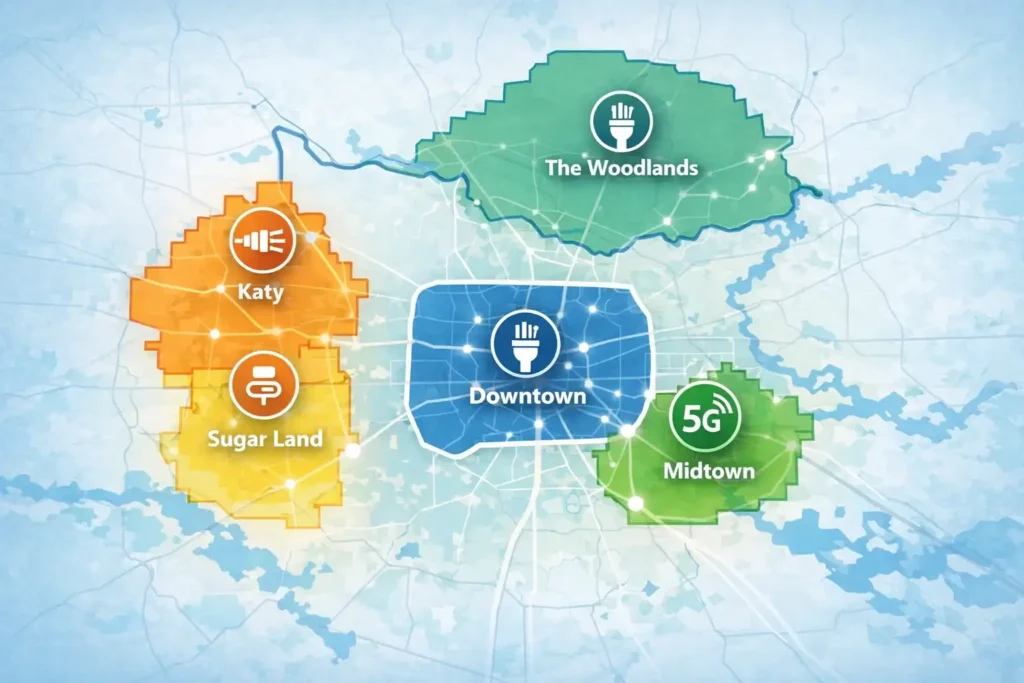
Fiber internet is provided through fiber-optic cables.
Internet delivered through cable TV lines
Internet delivered from nearby cellular towers
Fiber internet is generally the better option when available. It provides more consistent speeds, lower latency, and better upload performance, which is important for video calls and cloud-based work.
Cable internet remains a strong alternative for most Houston residents because it is widely available and can support streaming and multiple devices. However, cable connections may slow down during busy hours when many users are online at the same time.
Quick takeaway:
$55/mo
~300 Mbps
No
Promo pricing may end
$69/mo
~1,000 Mbps
No
Limited availability
$50/mo
~100 Mbps
No
Promo pricing may end
$35/mo
~150 Mbps
Yes
Data caps may apply
$50/mo
100 Mbps
No
No long-term contract
$55/mo
~100 Mbps*
Varies
Depends on partner network
$50/mo
100 Mbps
No
Limited coverage
Availability: Select Houston neighborhoods
Lowest Price Plan: ~$55/month
Typical Speed (lowest tier): ~300 Mbps
Best for: Remote workers, families, gamers
Availability: Growing coverage in Houston-area neighborhoods
Lowest Price Plan: ~$69/month
Typical Speed (lowest tier): ~1,000 Mbps
Best for: Fiber-ready neighborhoods, heavy users
Availability: Widely available across Houston
Lowest Price Plan: ~$50/month
Typical Speed (lowest tier): ~100 Mbps
Best for: Homes without fiber access
Availability: Select Houston areas
Lowest Price Plan: ~$35/month
Typical Speed (lowest tier): ~150 Mbps
Best for: Budget-focused households
Availability: Many urban and suburban areas
Lowest Price Plan: ~$50/month
Typical Speed (lowest tier): ~100 Mbps
Best for: Renters and apartments
Availability: Limited Houston locations
Lowest Price Plan: ~$50/month
Typical Speed (lowest tier): ~100 Mbps
Best for: Homes with strong Verizon 5G signal
Availability: Depends on partner network at your address
Lowest Price Plan: ~$55/month
Typical Speed (lowest tier): ~100 Mbps (varies)
Best for: Select neighborhoods and suburbs
Houston’s neighborhoods can have very different internet options. Newer developments and planned communities are more likely to have fiber, while older neighborhoods often rely on cable or wireless services.
Apartments may also be limited by building wiring and provider agreements. Always check availability using your full street address and unit number for the most accurate results.

Fiber first (AT&T Fiber, Ezee Fiber), cable second

Cable or fiber with unlimited data

T-Mobile or Verizon 5G home internet

Unlimited data fiber or cable plans
Customer service experiences in Houston can vary by provider and neighborhood. Larger providers offer wide coverage but may have slower response times, while newer fiber providers often receive higher satisfaction ratings. Reading local reviews can help you understand real-world reliability in your area.
Many Houston internet plans advertise low introductory prices that increase after the first year. Cable providers may charge equipment fees, and some plans include data caps that can result in extra charges. Always confirm regular pricing, data limits, and contract terms before signing up.
Fiber availability is growing but still limited to select neighborhoods. Many homes rely on cable or wireless internet.
Heavy rain and storms can affect wireless connections more than wired ones. Fiber and cable are generally more stable.
Most fiber providers and Spectrum cable plans offer unlimited data. Xfinity plans may include data caps.
5G can work well in strong coverage areas but may slow during congestion or bad weather.
Network expansion happens in phases, and infrastructure varies by neighborhood age and development.
Recheck every 6–12 months, especially in fast-growing Houston neighborhoods.
Houston offers many internet options, but availability and performance depend heavily on where you live. Fiber is the best choice when available, while cable and 5G home internet provide strong alternatives in other areas. By checking availability at your exact address and understanding how different connection types perform, you can choose a plan that fits your needs and budget.